
Loop it, read it, print it
This one is about the hours between the first try and the clean take. Play a pattern over and over without reaching for the screen, hear a click to hold it against, see which way each miss went — and take the groove away on paper when you close the laptop. The curriculum also reaches a hundred lessons, with nothing left marked "coming soon".
Every lesson, written out
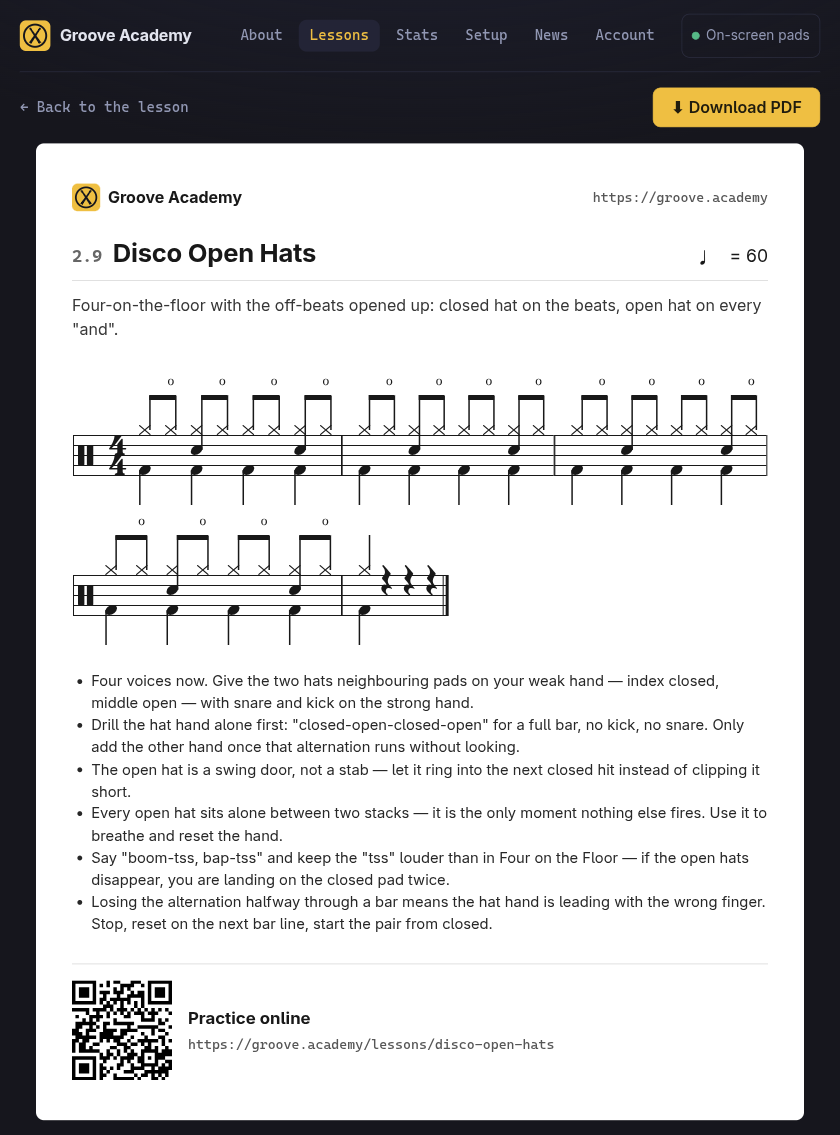
Press ♪ Notes beside Listen and the lesson is written out as drum notation: hands above, kick below, triplets bracketed, open hats marked, the way a drum book prints it. If you read music, a groove becomes something you take in at a glance rather than wait for on the highway. If you do not yet, this is a gentle place to start, because you already know how every one of these bars sounds.
The page is laid out as a sheet, and Download PDF turns it into one — for the music stand, the practice pad on the train, or a teacher. A printed page leaves the site behind, so it carries the way back: the address at the top and a QR code to the lesson at the bottom, under Practice online.
Loop it, with a click
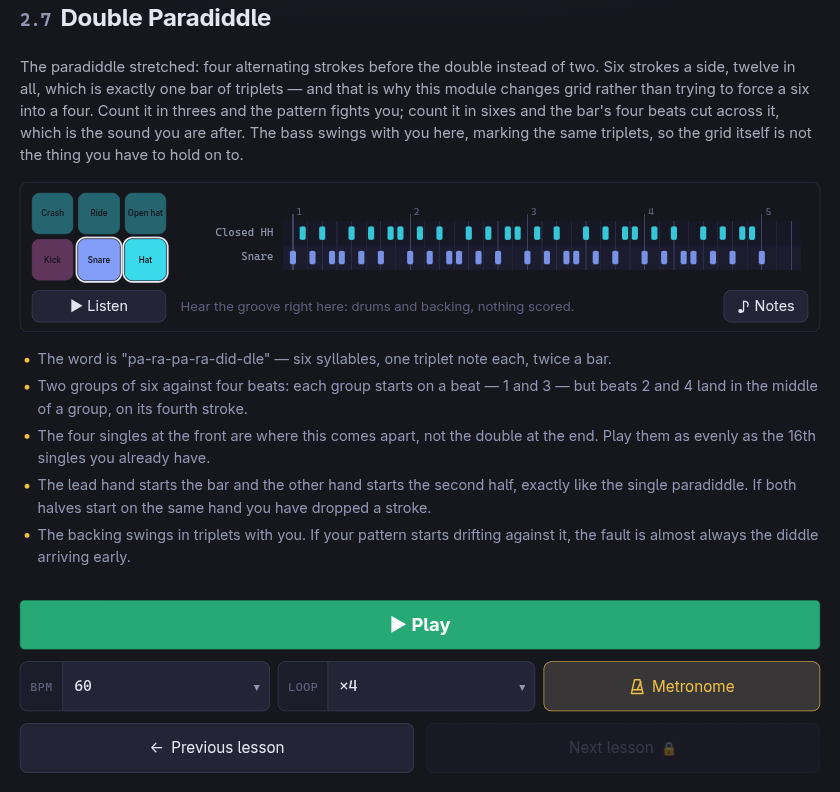
Set Loop to 2, 4, 8 and up to 64, and one press of Play runs the pattern that many times in a row. Nothing stops between passes and nothing doubles up: every lesson already ends on the down-beat that would have started it again, so each pass hands straight over to the next. The count-in leads you in once.
Metronome adds a click on every beat, a little higher on the one. The backing bass is there to make the groove feel like music, and by the end of a stage it deliberately stops marking the beat for you. The click is the opposite: the plainest possible reference, for when you want to know whether it is you or the bass that is moving. Both settings are remembered per lesson.
Which way you were off
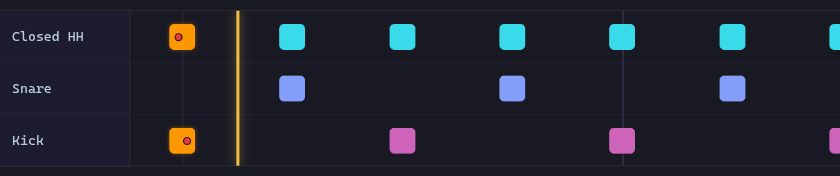
An orange note used to tell you only that you were off. It now carries a red dot that says which way: left of centre if you were early, right if you were late, and the further out it sits, the closer that hit came to being a miss. A row of dots all on one side is a habit, not bad luck — usually rushing, and usually on the beat you find hardest.
A hundred lessons
The Sticking stage is finished. Single strokes in 16ths, doubles in 8ths and then at 16ths, where a double stops being two strokes and starts being a bounce. The paradiddle in all four of its inversions, with the double moved to the front, the middle and across the join. Then three rudiments that only fit in threes — the double paradiddle, the paradiddle-diddle and the six-stroke roll — so that module moves onto the triplet grid rather than squeezing a six into a four. A checkpoint closes the stage, one bar of each.
Every one of them is two pads and one voice, so the whole stage is playable on a kit with no pedal. That makes a hundred lessons, and the catalogue no longer has a single greyed-out slot in it.
NUX DP-2000, corrected
Two of its pads were the wrong way round: pad four is the crash and pad eight the ride. Setup now also asks for its kick pedal before the hi-hat. A DP-2000 you set up before today picks up the correction by itself, with no drums left unlabelled on its picture.
That is the release. If something reads wrong on paper, or the click is in the wrong place for you, say so on Mastodon — and the lessons are where they always are, in the catalogue.